
Hampshire · Dorset · Sussex
Lintel Replacement & Repair
A cracked or sagging lintel doesn't always mean full replacement. We diagnose whether it can be repaired in-situ or needs replacing — and tell you honestly which, before any work starts.
Book a free survey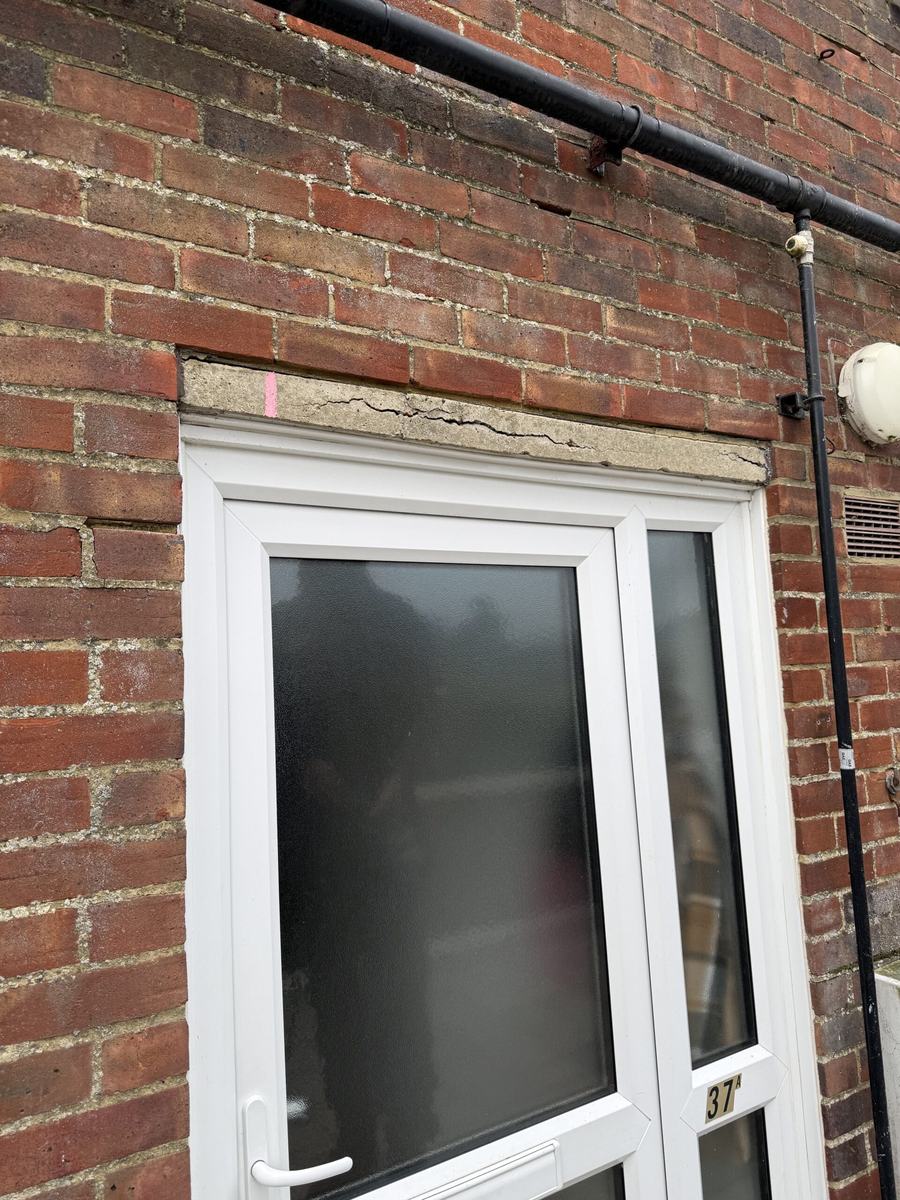
Signs your lintel might be failing
- Cracking in the brickwork directly above a window or door
- A visible gap, crack, or stepped crack along the line of the lintel itself
- Sagging or bowing brickwork above an opening
- Rust staining bleeding through above a concrete lintel — a sign of corroding rebar inside
- A door or window that's started sticking or no longer closes properly
- Spalling or visibly crumbling concrete on the lintel face
- A slipped or dropped brick arch above an opening
- Rotten or visibly decayed timber above a window or door — common in older properties with a timber lintel
The most common sign of a failed lintel is cracking above the opening — but cracking has several possible causes, so it's worth a proper diagnosis before assuming the lintel itself is to blame.
Repair, or replace?
Most companies only talk about replacement. That's not always the right answer, and we'd rather tell you the truth than sell you the bigger job.
When repair makes sense
If a concrete lintel is showing early corrosion — spalling, rust staining, exposed rebar — but hasn't lost structural capacity, an in-situ repair using a structural repair mortar can treat the steel and rebuild the section without removing the lintel at all. Less disruptive, and usually less expensive than replacement.
When replacement is necessary
Once a lintel has failed structurally — significant bowing, deflection, or a steel lintel that's corroded through — repair won't hold. At that point replacement is the safer, more reliable route, even though it's the bigger job.
A third option: masonry beaming
Where the lintel itself is sound but the masonry above it is cracking under load, a masonry beam — helical bars bonded into the surrounding brickwork — can take the strain off without touching the lintel at all. See our Crack Repairs page for more on this technique.
How we replace a lintel
When replacement is the right call, here's the process, step by step.
1. Temporary structural support
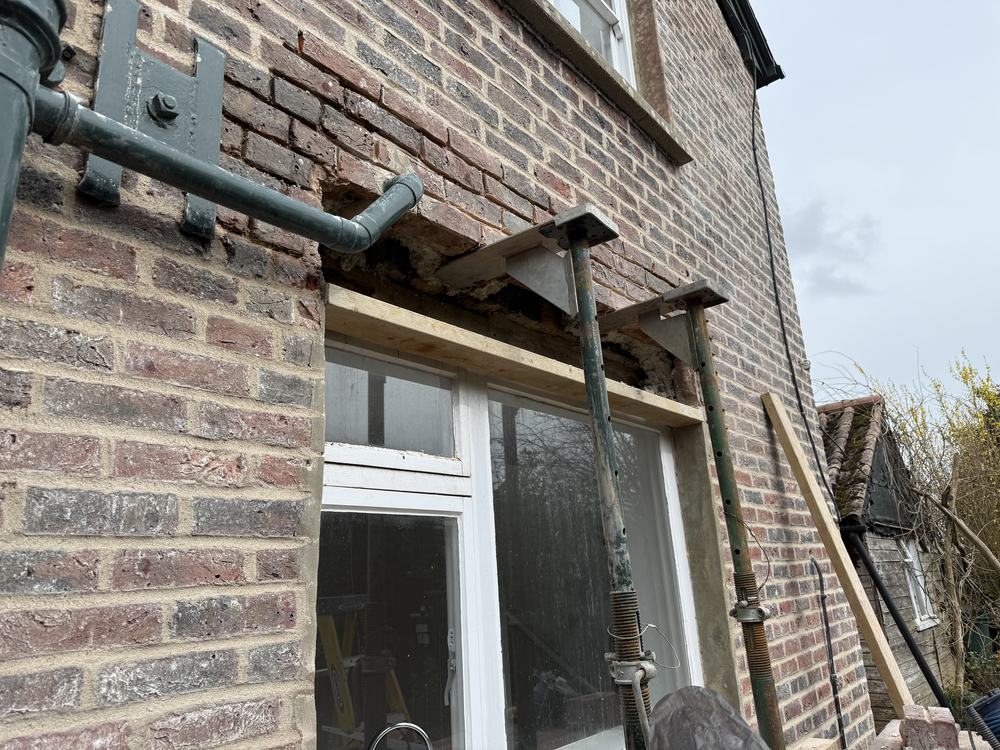
Before removing anything, the opening is properly supported — Acrow props and strongboys for standard lintels, needle beams for larger openings, custom bracing for period properties and decorative arches.
2. Removing the existing lintel
The method depends on the lintel type. Concrete lintels are carefully cut and extracted, sometimes needing specialist cutting tools. Steel lintels have their fixings removed and are slid out, with any rust addressed as we go. Boot lintels — see below — need both skins of brickwork supported to come out safely.
3. Installing the new lintel
We fit a structurally appropriate replacement — precast concrete for cost-effective strength, galvanised or stainless steel for durability, a boot lintel where the original design calls for it, or a custom arched lintel for historic properties.
4. Rebuilding and finishing
Brickwork, mortar, render, or plaster is made good around the new lintel, blending it back into the existing wall for a finish that doesn't look like anyone's been there.
Boot lintels — why they're different
A boot lintel is shaped to support both the inner and outer skins of a cavity wall in one unit — named for its boot-shaped cross-section. Unlike a standard lintel, the outer toe has no bottom bearing surface; it relies entirely on the inner masonry leaf for support. Where that bearing isn't capable of properly spreading the load, the lintel can rotate slightly over time, opening up stepped cracking in the brickwork above — sometimes before any reinforcement corrosion is even involved. They're also more involved to replace than a standard Catnic-style lintel, because both skins of brickwork need supporting throughout the job, and the amount of making good afterward is usually greater. We've replaced and repaired boot lintels across coastal properties throughout Hampshire, Dorset, and Sussex, where corrosion from sea air is a recurring contributing cause.
Slipped brick arches and rotten timber lintels
Not every failure is a concrete or steel lintel corroding. Brick arches above openings can slip or drop over time, particularly in older properties, and need careful dismantling and rebuilding to restore the original shape. Timber lintels — common in older housing stock — rot from the inside out, often invisibly until the damage is significant; once decayed, the timber is removed entirely and replaced with a modern concrete or steel equivalent, with the surrounding brickwork made good to match.
Lintel replacement and repair cost
Prices typically start from £800, and can rise significantly depending on size, lintel type, and access — we've seen jobs exceed £2,500 where the lintel itself was over 4 metres long. It's genuinely not a one-size-fits-all job, so here's what actually moves the price:
- Size of the opening — the bigger the span, the more complex the support and installation
- Lintel type — a standard Catnic-style lintel is straightforward; a concrete boot lintel needs both skins of brickwork supported, which adds time and cost
- Damage to surrounding masonry — cracked brickwork may need replacing or re-rendering alongside the lintel itself
- Access — ground-floor openings can often be reached with a hop-up or mobile tower; first-floor and higher usually need scaffolding
If repair is genuinely viable instead of replacement, it's almost always the cheaper route — which is exactly why we check first rather than assume. A site survey is the only reliable way to know, and ours are free.
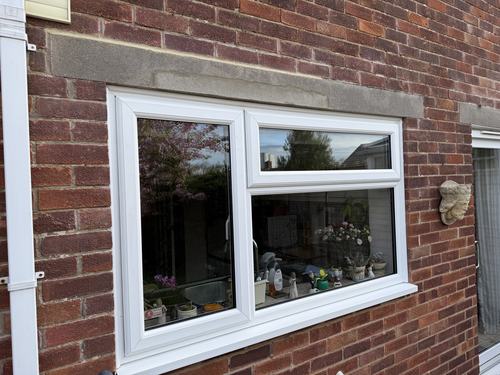
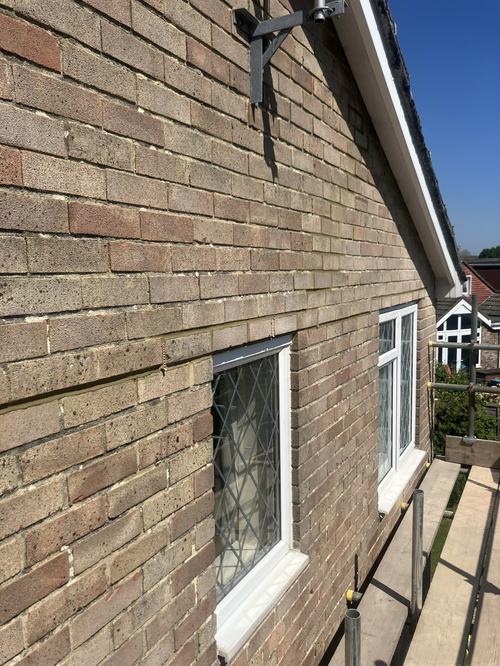
Southampton · recent project
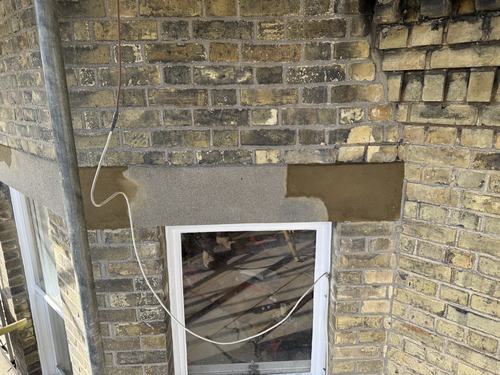
Slipped soldier course, no original lintel
The problem: A soldier course of brickwork above an opening had slipped, with no lintel originally installed to support it — a common issue in older properties.
The cause: The brick bond alone was never adequate to carry the load above the opening long-term.
The fix: A new angle iron lintel installed where none existed before, bricks re-laid and pointed in lime mortar to match the wider repointing work happening on the property at the same time. Completed in one day.
Common questions
Can I repair a lintel instead of replacing it?
Often, yes. A concrete lintel can sometimes be repaired in-situ to treat corroding rebar and rebuild the spalled section, which is less disruptive and less expensive than full replacement. However, once a lintel has failed structurally, replacement is usually the more reliable long-term option. A site survey identifies which applies to your property.
What is a boot lintel?
A boot lintel is a concrete lintel shaped to support both the inner and outer skins of a cavity wall in a single unit, named for its boot-like cross-section profile. They're more complex to replace than a standard lintel because both skins of brickwork need supporting during removal, which increases both the time and cost involved.
How much does lintel replacement cost?
Prices typically start from £800, and can rise significantly depending on size, lintel type, and access. Larger or more complex jobs, such as a long boot lintel requiring scaffolding, can exceed £2,500. A free site survey gives an accurate, fixed-price quote.
Cracking above a window or door?
Get a free, honest assessment of whether it needs repairing or replacing — we'll tell you which, and why, before any work starts.
Book your free surveyYour data is always safe with us. We'll only contact you about your enquiry, and we never share details with third-party marketing organisations.
Areas we cover
Lintel replacement and repair across Portsmouth, Southampton, Brighton, Bournemouth, Guildford, and the wider Hampshire, Dorset, and Sussex area.