
Polegate, East Sussex · Concrete Repairs · 2024/11
Boot Lintel Repairs to a Parade of Shops
19 concrete boot lintels, spalled and delaminated from coastal corrosion, reinstated using Fosroc structural repair mortar — completed in around a week with minimal disruption to tenants.
The problem
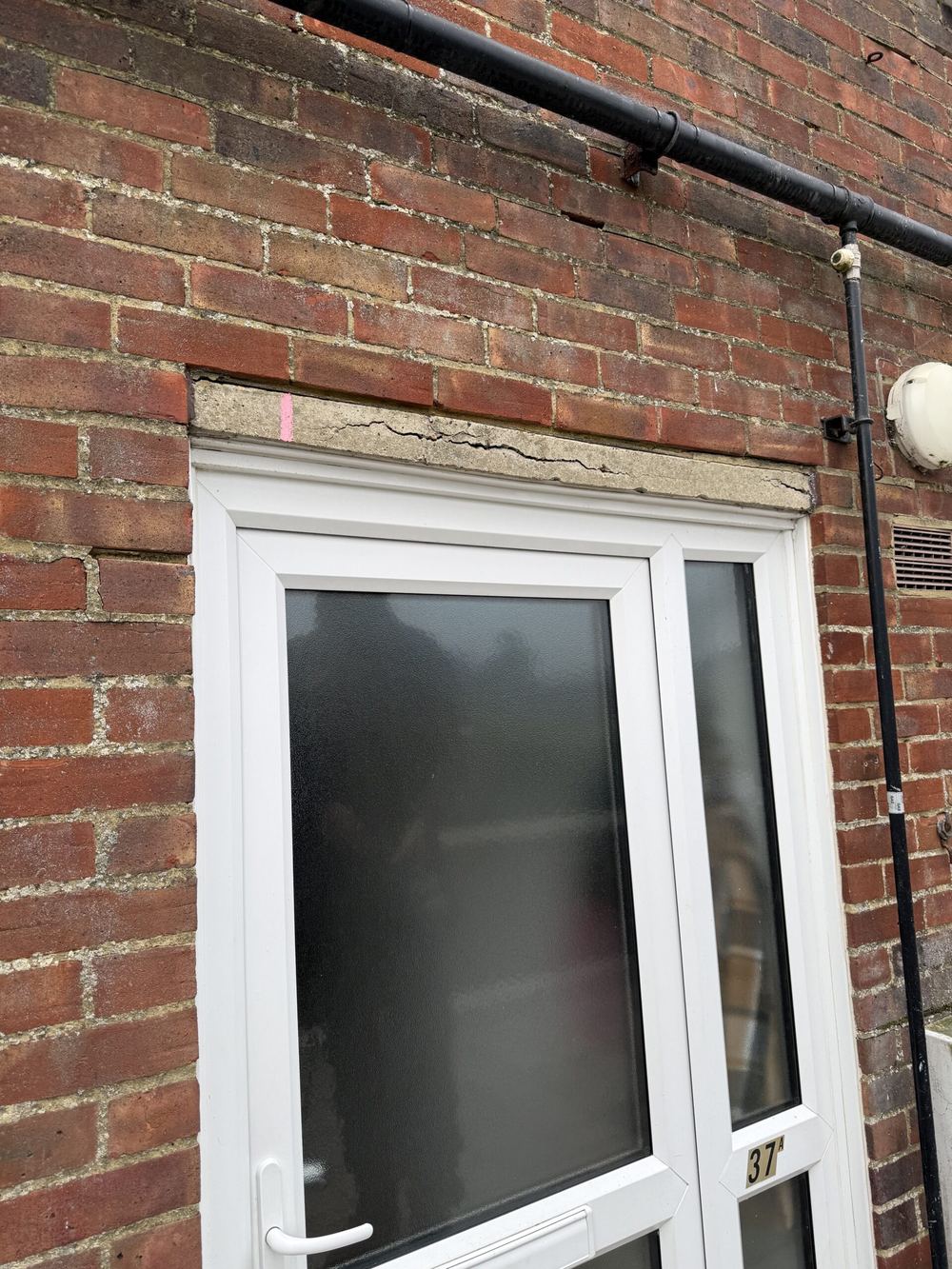
We were appointed to carry out concrete repairs to a parade of shops with flats above in Polegate. The job involved 19 concrete boot lintels showing spalled and delaminated faces to the rear elevations of the commercial units and the maisonettes above — cracking, exposed and corroding reinforcement, delamination of the concrete cover, and localised cracking across multiple elevations of the building.
The cause
The deterioration was typical of coastal and near-coastal buildings of this age: inadequate original concrete cover during manufacture, age-related wear, chloride exposure from proximity to the coastline, and long-term moisture ingress. As the embedded reinforcement corrodes, it expands and exerts tensile force within the concrete — once that force exceeds the tensile capacity of the cover, cracking and spalling follow.
Boot lintels carry a particular vulnerability of their own. Unlike a standard lintel, a boot lintel's outer toe has no bottom bearing surface — it relies entirely on the inner masonry leaf for support. Where that inner bearing isn't capable of properly spreading the load, the lintel can rotate slightly over time, which on its own can open up cracking even before any corrosion sets in. Combined with reinforcement corrosion, it's a pattern we see regularly across similar mixed-use buildings in Sussex, and one reason boot lintels need a different diagnostic eye to a standard lintel.
What we did
We carried out repairs to all 19 lintels using a mobile access tower, which gave safe, controlled access while keeping disruption to the occupied shops and flats above to a minimum — no full scaffolding required.
- Break out. All defective and delaminated concrete was mechanically broken out back to sound substrate, undercutting behind the corroded reinforcement to allow it to be fully encapsulated by the new repair material, with particular care taken to remove every trace of contaminated concrete.
- Reinforcement treatment. Exposed steel was cleaned of corrosion products and treated to inhibit further oxidation — the step that actually prevents the problem recurring, not just patches over it.
- Reinstatement. Lintel faces were rebuilt using a Fosroc structural repair mortar, chosen for its performance in marine-influenced environments, applied to manufacturer guidance for proper bond, compaction, and curing. Every profile was reinstated to match the original lintel geometry for a consistent finish across the elevation.
The result
The repairs were completed in around a week, with careful sequencing to keep tenants safe and minimise inconvenience throughout. This job is a good example of how seemingly minor spalling can point to underlying reinforcement corrosion or lintel rotation, not cosmetic damage — correct diagnosis, full removal of contaminated concrete, proper steel treatment, and a genuinely compatible repair mortar are what make a coastal repair like this actually last.
Noticed similar cracking or spalling?
Cracking, spalling, or exposed reinforcement around door and window openings is often an early sign of reinforcement corrosion. We recommend getting it assessed before deterioration accelerates — especially in coastal or near-coastal properties.
Book your free surveyYour data is always safe with us. We'll only contact you about your enquiry, and we never share details with third-party marketing organisations.