
Bournemouth, Dorset · Crack Repairs · 2024/12
Masonry Beam Installation
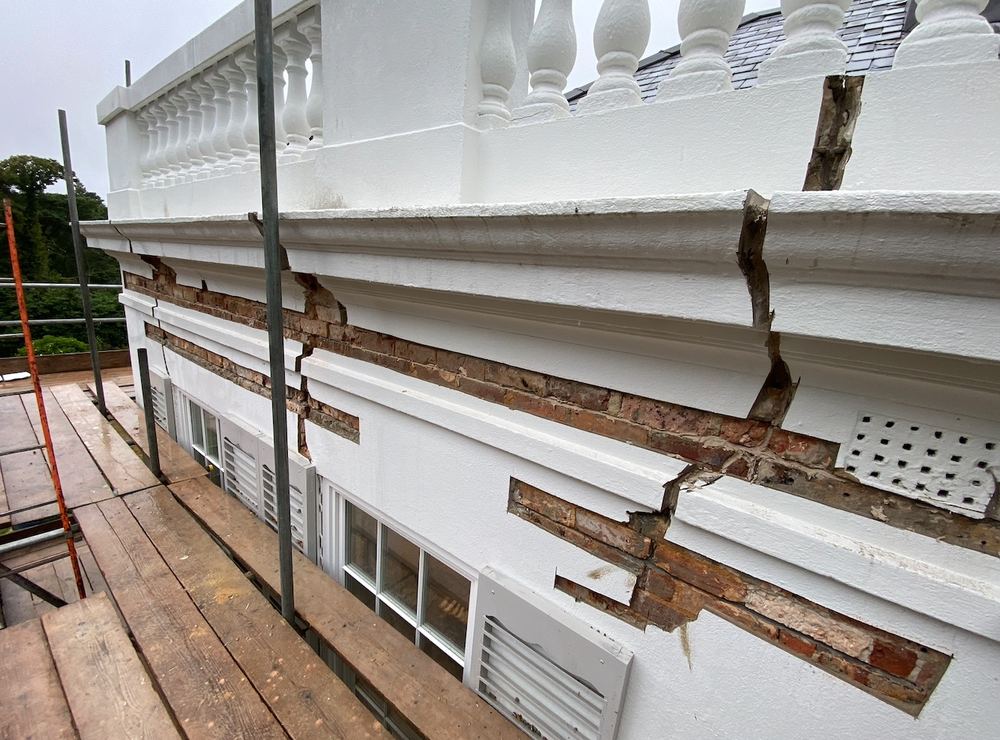
Severe stepped cracking through painted render and brickwork along a cornice line, stabilised with a concealed masonry beam — restoring strength without disturbing the building's character.
The problem
The homeowner had noticed cracks forming on the rear elevation and called us in to assess the issue. On inspection, the cracking ran straight through the painted render and into the brickwork beneath, concentrated along the cornice line beneath an ornate balustraded parapet — visually dramatic, and in this case genuinely structural rather than cosmetic.
Why a cornice line specifically
Cornices and parapets are some of the most exposed parts of any building, fully open to the weather on multiple faces, which makes them especially prone to thermal expansion and contraction, moisture cycling, and freeze-thaw damage over time. They also tend to combine several different materials and construction methods in a small area — the brick beneath, a painted render or moulded finish on top, and a roofline above — each reacting differently to temperature and moisture, which creates exactly the kind of differential movement that opens up cracking at the junction.
The cause
A wall spanning between two points of support without something solid directly underneath effectively has to act like a beam — and a beam under load is in tension along its lower edge, compression along its upper edge. Masonry is strong in compression but genuinely poor in tension, so where a section of wall is forced to beam in this way, the bricks at the tension face pull apart and crack. That's exactly the pattern we found here: the cornice section had no continuous structural support directly beneath it, so seasonal movement and seasonal thermal cycling had been pulling the masonry apart at its weakest point, the render and brick at the lower edge, for some time before it became visible.
What we did
- Removed defective render from the affected area to expose the brickwork beneath and assess the true extent of the cracking.
- Cut bed joints into the existing brickwork at two parallel courses along the cracked section — the upper and lower flanges of what becomes a concealed reinforced beam.
- Installed stainless steel helical bars into both bed joints, bonded in place with a high-strength grout. Used in this paired, two-course arrangement, the bars work together as a genuine masonry beam, redistributing tension and compression loads across the reinforced section rather than relying on the brick alone.
- Completed all finishing work, repointing and re-rendering to blend seamlessly with the original painted finish, so the repair is invisible from the outside.
The result
The work was completed efficiently with minimal disruption to the homeowner. The masonry beam now carries the tension and compression loads that were previously concentrated on the unreinforced brick and render, addressing the actual structural cause rather than the visible symptom — the kind of fix that holds for the long term rather than needing to be revisited every few years as the cracking reopens.
Cracking forming on your property?
Cracks that run through render and into the brickwork beneath are worth a proper survey, not a guess. We'll tell you honestly what's causing it and what it actually needs.
Book your free surveyYour data is always safe with us. We'll only contact you about your enquiry, and we never share details with third-party marketing organisations.